The Longer the Program, the More Idle Capital Costs: An Evergreen Private-Credit Study
Private credit has become one of the larger destinations for institutional capital, and most of it is accessed the same way private equity is: an LP commits to a fund, and the money is drawn over years, on the manager's schedule. That structure creates a quiet drag. Committed capital that has not yet been called has to live somewhere — cash, a short-duration sleeve — earning a fraction of the credit return the allocation was sized for. The commitment is on paper; the exposure is not yet in the ground.
This drag is the same structural gap between committed and invested capital that shows up across private markets (the commitment you can't choose); this study looks at how large it is in private credit specifically, and how it behaves as a program is run over a longer horizon. The figures below come from a loan-level model of a private-credit program — every underlying loan and every cash flow modeled explicitly, then aggregated to the program — run under illustrative assumptions. They are illustrative, not a forecast of any specific program.
The starting point: a third of a single fund's commitment can sit idle
Commit $100M to a single private-credit fund and trace the capital. It is called down over the investment period, deployed into loans, and returned as those loans pay coupon, PIK, and principal. Across that life, a meaningful share of the committed $100M is never simultaneously at work: early on it has not yet been called, and later it has already been returned. In the modeled single-fund case, on the order of 30% of committed capital spends its life idle rather than earning the credit return — a real cost that standard reporting is silent on, because the usual performance metrics are computed on the capital that was invested, not the capital that was committed.
Running it as a program changes the picture — and not for the better, if left passive
An LP maintaining private-credit exposure does not hold one fund; it runs a program — a continuing series of commitments to successive funds so that maturing capital is replaced. A program is what an evergreen private-credit allocation actually is: to stay perpetually invested, an LP commits continuously over a long, open horizon, so that as older funds wind down, newer commitments keep the exposure in the ground. (This is the evergreen structure viewed as a program rather than a single vehicle — the structural trade-offs of the evergreen turn apply here too.)
Modeled that way, the idle-capital problem does not shrink — it can deepen. A program that commits mechanically, in equal annual tranches, layers each fund's deployment lag on top of the last. In the modeled three-year, multi-fund program, the share of committed capital at risk of sitting idle rose to roughly 40%. Simply spreading commitments across vintages, without managing the timing against the program's actual deployment and run-off, leaves more capital waiting, not less.
The finding: the cost of idle capital grows with the horizon
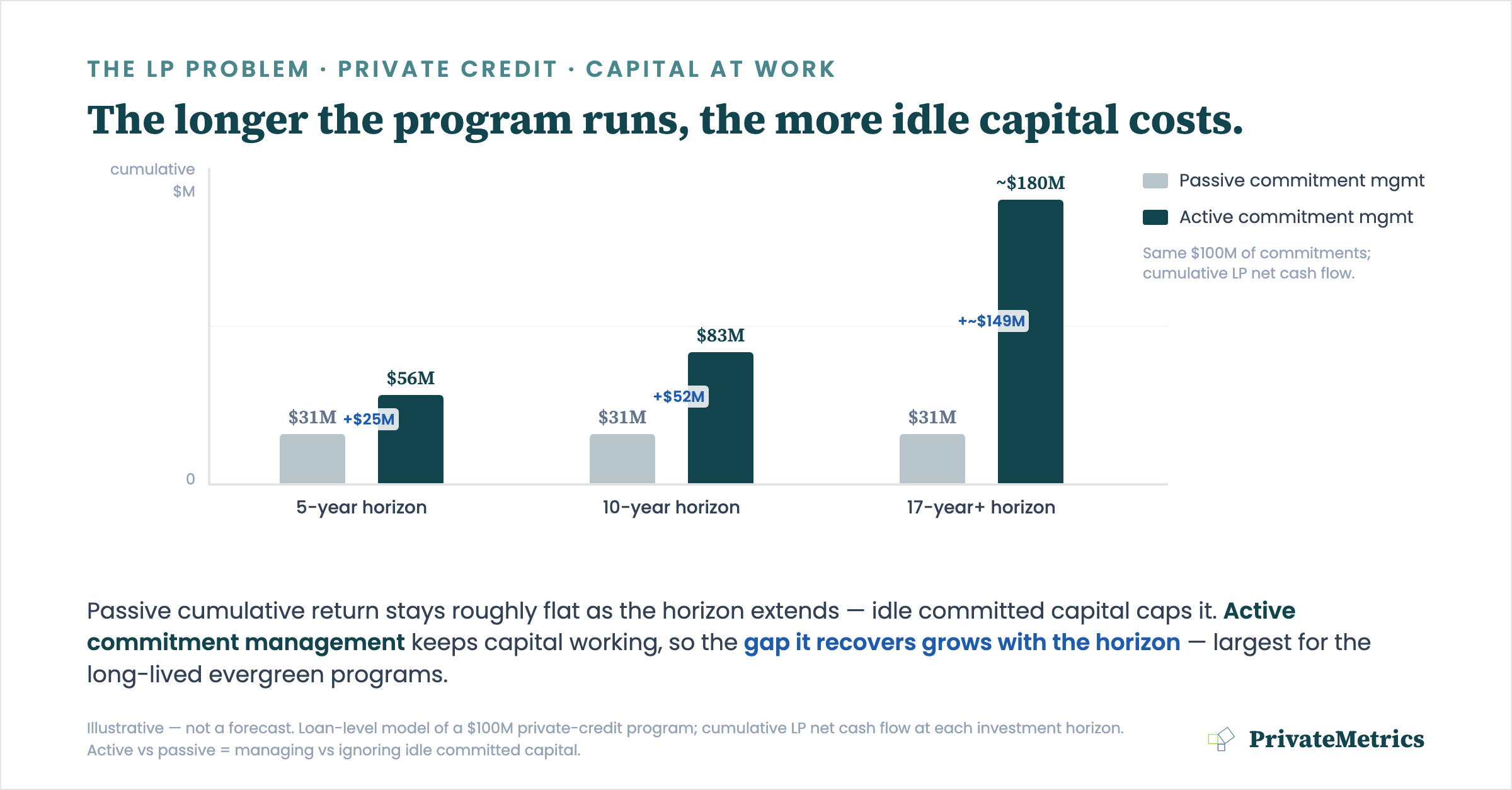
The central result is what happens as the program's investment horizon lengthens. The study compares two ways of running the same $100M of commitments:
- a passive program that commits in fixed, equal tranches, and
- an actively managed program that sets each period's commitment against the program's projected deployment and run-off, so that committed capital is converted into working capital as efficiently as the liquidity constraints allow.
Over a five-year investment program, the actively managed version produced materially more cumulative return than the passive one — on the order of $56M versus $31M in the modeled case. Extend the same program to a ten-year investment horizon, and the gap widens further; extend it toward the multi-decade horizons that define a genuinely evergreen allocation, and it widens further still. The reason is structural: the longer the program runs, the more commitment cycles there are in which capital can be left idle — so the return recovered by managing that idle capital compounds with the horizon rather than staying fixed.
This is the part that matters for an evergreen private-credit allocator specifically. The evergreen appeal is that capital stays continuously invested over a long horizon — but "continuously committed" is not the same as "continuously invested." Over a long horizon, the difference between the two is exactly where the cost accumulates, and it is largest precisely for the long-lived programs evergreen structures are built to run.
Why loan-level detail is the point
A finding like this is only trustworthy if it is built from the bottom up. The model does not assume a program-level cash-flow curve; it constructs one, loan by loan — each loan's drawdown, coupon, PIK accrual, and principal return — then aggregates loans into funds and funds into the program. That resolution is what lets the analysis separate committed from invested capital honestly at every point in time, rather than inferring the gap from a smoothed aggregate. It is also what makes the model an experiment engine: the same loan-level structure supports asking a wide range of LP questions — how default timing flows through to distributions, how PIK versus cash-pay reshapes the liquidity profile, how the waterfall splits returns between the LP and the manager — each answered with the same bottom-up detail.
What an allocator can take from it
Three points carry over to a real program:
- Measure the whole program, not just the invested part. The idle-capital drag is invisible to metrics computed only on invested capital. It has to be measured against committed capital to be seen at all.
- Treat commitment as a managed decision. The gap between passive and active commitment management is not a modeling artifact — it is return left on the table by treating the commitment schedule as mechanical rather than as a decision to manage against projected liquidity.
- The stakes rise with the horizon. For a long-horizon or evergreen private-credit program, the cost of getting this wrong is not a fixed tax; it grows the longer the program runs.
The Design Partner Program is a selective deployment for institutions battle-testing the platform. If idle committed capital is a drag on your private-credit program — and you would like to see it measured loan by loan — that is exactly the kind of question the platform is built to answer.